Karma is, famously, a cycle. This cycle governs the functioning of the higher, Spiritual realms of our life’s journey.
This is the second article in my series titled ‘Cycles of Life’ where I look into the concept of Cycles as I see them in the Major Arcana.
Cycles are an inherent part of life – everything in life moves in a circular fashion. The Karmic cycles are an inherent framework that governs the higher levels of life.
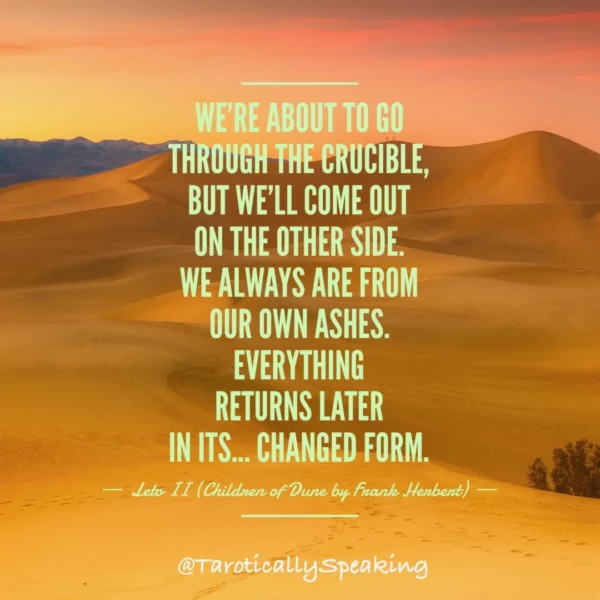
One of my favorite quotes from Children of Dune summarizes it perfectly: “The beginning and the end are one. […] A phase has closed. Out of that closing grows the beginning of its opposite. […] Everything returns later in its changed form.” 🙂
Today, let’s look at a pair of cards from the Major Arcana that describe this kind of cycle – The Wheel of Fortune and Judgment.
This time, we are going to look into a very important and very interesting cycle (and of course, the ways it has been conveyed in the Tarot cards): the Karmic Cycle.
Karma Theory
I suppose, since I grew up as a Hindu, I can accept the Karma theory pretty easily. In its simplest form, you can understand the theory of Karma as a process of Cause-and-Effect.
Without going into far too many complicated explanations, let’s look at the basics of Karma Theory before we look at the cards in its light.
The word ‘Karma’ literally means ‘Action’. So, your Karmas are essentially your actions. And actions (if you must classify them in a very black-and-white manner) can be divided up into ‘good’ and ‘bad’. Naturally, the ‘good’ actions help you get good points and vice versa. And if you throw in the entire logbook of Karmas from all your different lifetimes, then you can imagine how much Karmic balance each of us can really acquire!
According to the Karmic Theory, our Karmas can be classified into 3 main types:
- Sanchita Karma: the sum total of accumulated Karma,
- Prarabhdha Karma: that part of your accumulated Karma which affects your current lifetime, and
- Kriyamana Karma: the Karma that you are creating, right now, with your current actions.
Oh Boy! Does this cycle ever end?
Criticism of the Karma Theory
The Karma theory does come under a lot of flak from people for a variety of reasons. While logical people can trust the cause-and-effect connection, many among us cannot trust the concept of accumulated Karma – especially from past lives.
Many see Karma as a convenient scapegoat for explaining away situations and experiences in life that cannot be explained through cause-and-effect scenarios.
However, with the Tarot cards, one can easily gain a deeper understanding of the origin of the cause – and thus learn more about the Karma associated with the effect in question.
The Wheel of Fortune: The Wheel of Karma

The Wheel of Fortune is one card that really goes into the essence of the entire gamut of Symbolism vis-à-vis Karma.
Notice the four angels sitting at the four corners of the card – and the books that they are holding? Well, these are the Akashic Books. And each of these angels represents one of the elements of Nature – the angel with a man’s face represents Air, the Eagle-faced angel represents Water, the Bull-faced angel represents Earth, and the Lion-faced angel represents Fire. All these angels are recording your actions in the Akashic Books.
Then of course, right in the center of the card is a Wheel. Nothing explains cycles, and especially Karmic cycles, like the symbol of a wheel. As the wheel turns, Fortune smiles and frowns upon us. Essentially, depending on how the wheel turns, we face either the consequences of our good deeds or our bad ones.
And let’s not forget the Egyptian deities Set (the snake), Anubis (the Jackal-headed guy raising the wheel), and Horus (sitting on top of the wheel), who also pretty much tell the story of actions and consequences. In the myth, Set kills Osiris (who is Horus’ father), and Horus eventually avenges that by killing Set.
The symbolism becomes even more interesting with the presence of Anubis – who, as it stands, is the force bringing the wheel back up from the depths – and who (interestingly) is the son of Set. He serves Osiris in the Underworld by leading the souls of the dead to be judged.
Remember that quote from before: “Out of that closing grows the beginning of its opposite”?
Evil/bad actions carry the seeds of their own destruction. And it is from these depths that one often witnesses the rise of the driving force that completely annihilates this very evil.
The pictures in The Wheel of Fortune card are a very straightforward lesson in Karma theory – and with just a few symbols, we see the different aspects of Karma.
We can see how actions and their consequences flow in a circular manner – one leading to the other, and the other leading to the next and so on. Each action leads to a consequence, which then leads to another action – thus creating an infinite loop.
As the Wheel can turn endlessly, so can this Karmic cycle continue – having no end in sight, infinitely. Those who manage to find a way out of this constant cycle of cause and effect are those whom we call ‘Enlightened’. And among those Enlightened are the ones who choose to return to this world to help others find their path towards Enlightenment. In Buddhist philosophy, these Enlightened ones are called Bodhisattvas.
Judgment: Karmic Wake Up Call

Another card that conveys the concept of Karmic cycles is Judgment.
The picture on this card shows the scene of ‘Judgment Day’ as described in the Bible. The angel blows the trumpet, and all the souls who have done good deeds and actions rise up from their coffins and go to heaven.
But I see a very different story in these pictures. I see endings of certain long and hard Karmic Cycles. I also see the angel providing a spiritual Wake-Up Call that pushes us into a state of awareness and action, helping us move past the final barriers of the Karmic cycles we are caught up in.
Each of us accumulates a whole lot of Karmic balances over different lifetimes. And we deal with various Karmic cycles in each lifetime. To me, the Judgment card represents the ending of one such long and rough round of Karmic balance accumulation.
The angel blowing the trumpet, to me, also signals the Universe’s sign that the cycle is finally over, and the people getting up from their coffins and rising represent freedom from a long wait or a long struggle.
I say this because of two reasons: (1) this is the second-to-last card in the Journey of the Fool – which means that the sum total of the Karmic balances is not yet over, and (2) this is the twentieth card – which means the Fool has come here after a long and hard journey. There are still more things to do before one can reach the state where all the Karmic Cycles have ended.
Tarot + Karma

The Tarot cards can serve as a very effective means of finding out the true reasons or causes behind situations for which one cannot find a logical cause right away. By simply asking the cards for the reason, one can gain a deeper understanding of a particular situation.
From personal experience, I can tell you that several times the cards have shown me causes that were present right under my nose, but I was too close to see them clearly. And then there have been those times when the cards have pointed out causes that originated in some other lifetime.
Your Turn
Have you used the Tarot cards to look into the causes of a particular situation? Do you have any particular cards, which, to you, signify Karmic Cycles? Which cards are they? Why do these cards talk about Karma to you?
Let’s talk about it in the comments section below.


Comments
One response to “Major Arcana: Cycles of Life – II: Karma”
[…] Contact Me ← Major Arcana: Cycles of Life II […]