
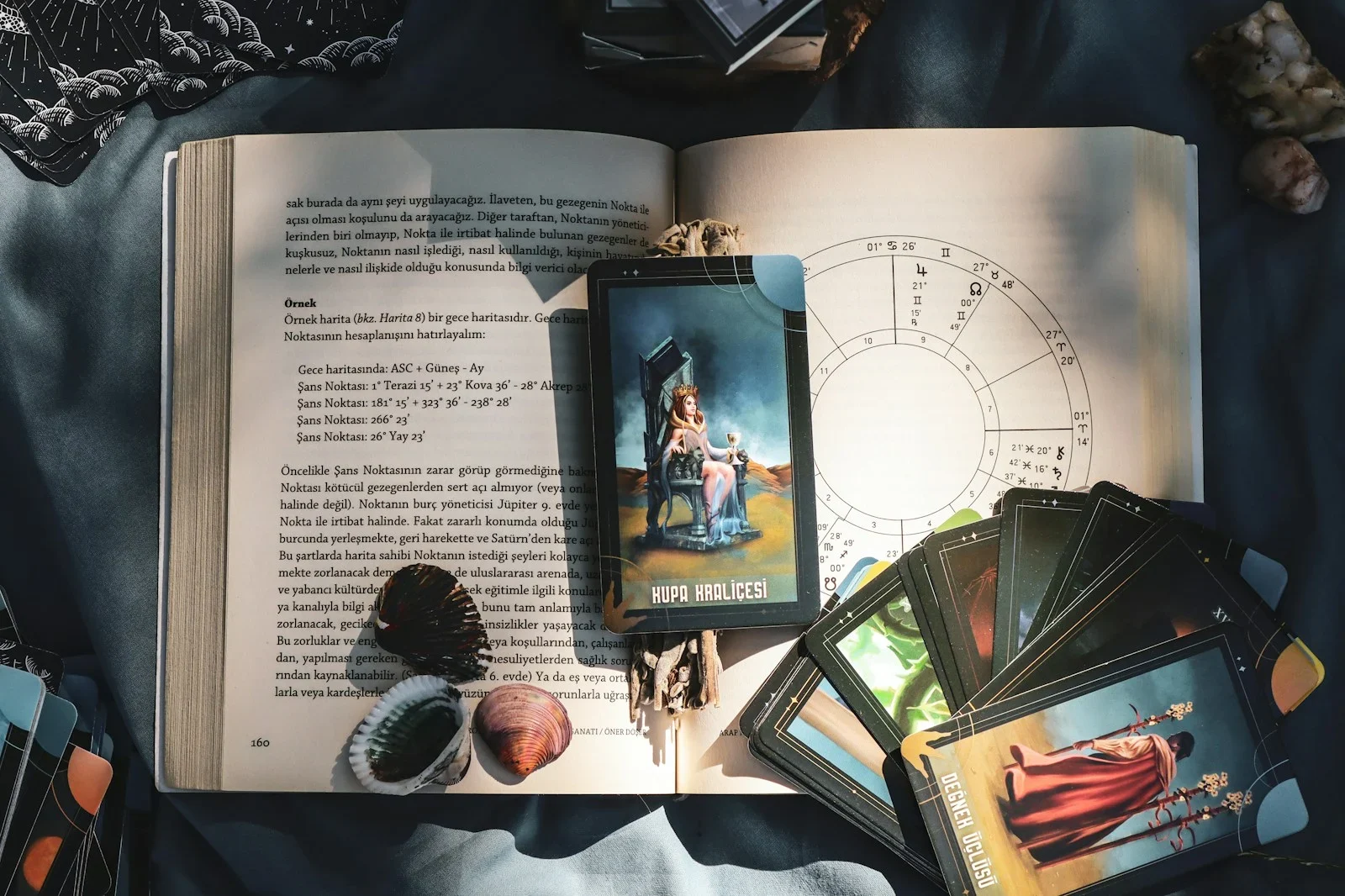
Tarot journaling plays a very important role, especially when you are studying the Tarot on your own. Here’s how I use the Tarot Journaling Self-Study process to enhance my study of the Tarot and keep track of my reading accuracy.
If you are studying the Tarot on your own, it makes sense to keep a Tarot Journal to record all your notes and thoughts.
Get a ring binder or a notebook, or fire up one of your note-taking apps. Add as many papers as you like to the binder. Add colorful drawings of card symbols that attracted you in the margins of your notebook. Add pictures of the card to your journal page for easy reference.
Tarot Journaling Self-Study: Record Your Readings
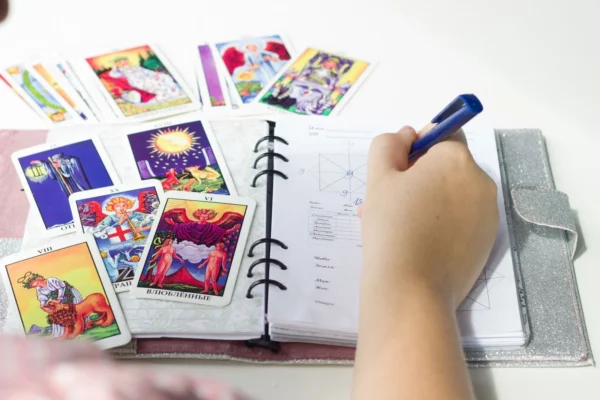
Keep records of your readings. This is the best way to track the accuracy of your readings.
Depending on whether it is your own reading, or a reading for a friend, or a client, you can record:
- The date and time of the reading, and the name of the person you were reading for.
- The details of the situation that make it relevant to your interpretation.
- Make sure you note down the Tarot Deck you used, the Spreads you used, and the Cards you pulled. Nowadays, you could even take a quick picture of the spread with your phone camera.
- Make a note of the specific interpretations that you made during the reading. If you had a sense of timing, or anything else, note it down.
- Write down what you felt, or what specific thoughts popped into your mind for you to make that interpretation.
- Check back after some time, and note down the similarity or the difference between what you had written down and what actually transpired.
Sometimes, writing down each and every reading may feel quite tedious. Indeed, if one does many readings (especially as a professional), things can get hectic pretty fast. So, I record the entire reading and take pictures of the spreads we pull. Eventually, as the apps evolved, I was able to annotate the questions onto the images themselves, making it easy to look at the spread later.
Tarot Journaling Self-Study: Learn the Tarot Card Meanings

You can also do a version of this process when you are studying the Tarot and learning the Tarot Card meanings.
- Make a page for each card.
- Write down the words and phrases that come into your mind when you see the card.
- Do this for the upright and for the reversed positions as well.
- Do this for 78 cards.
- Whenever a meaning is enhanced or added to your mental list, add it to your journal.
- Write down more about what happened (specific to the cards) to inspire you to this particular interpretation of the card’s meaning.
Later on, as life unfolds, you can return to your Tarot Journal and make a note of the accuracy of your interpretation. You can understand how or why you made your interpretations, and how closely they matched how events transpired in real life.
All of this will ultimately make you a better Tarot Card Reader. As the old saying goes, “Practice makes you Perfect” — and what better way to get feedback for your interpretations of the cards!
Buy the Tarot journal I made as I studied the Tarot



Your Turn…
Did you keep a journal as you studied the Tarot card meanings? How has Tarot Journaling Self-Study helped and supported you in your Tarot learning process? What has your experience been like? Do you have any specific things you do in your Tarot Journaling self-study method? Do you have any tips or ideas for me? Please share them in the comments section below.







Comments
One response to “Tarot Journaling: Self-study”
It seems voice is yours but words are coming from osho. Why it is so i dont know?
Do you know?