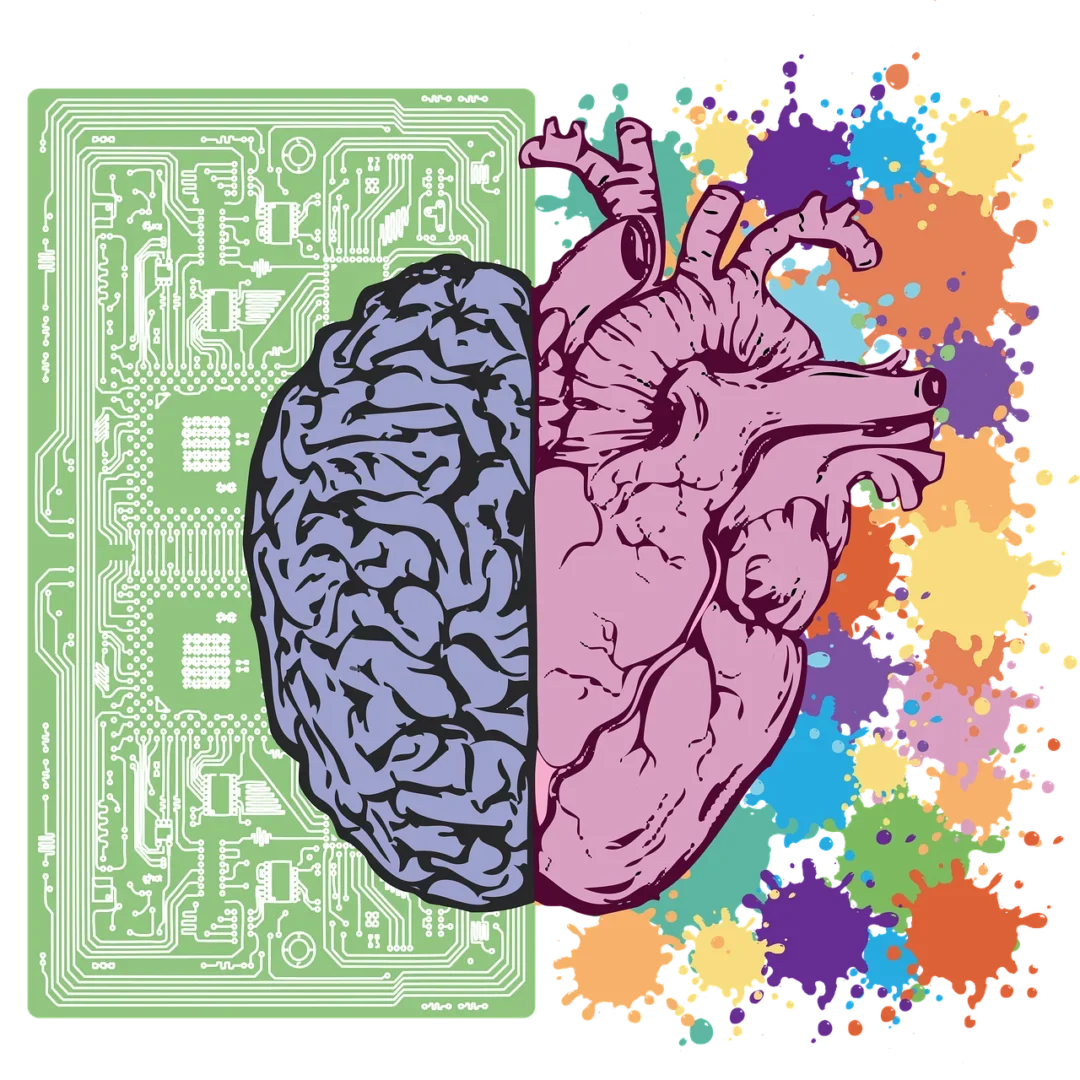
Let’s talk about AI, especially about Tarot and AI. I’ve been sitting with this one for a while, turning it over, arguing with myself about it — and I think it’s time I go on record with my stand, explaining my case for and against AI.
Here’s the short version: AI is a tool. Like every tool we’ve ever made, it can be used for good or for harm, and which way it goes depends entirely on the person holding it.
Interestingly, the Tarot is often considered to be “a wicked pack of cards,” even though it is the intent of the user, of the Tarot Card Reader, that will ultimately drive how those Tarot Cards are used. At times like these, we often tell people to beware of scam artists who scare you into spending money to buy products and services so they can help you to “get rid of a curse” or some such nonsense.
And yes, I know that there’s a difference between Tarot and AI. Of course! But the principle still holds. Here’s a tool that can be used for good or for evil. So the most sensible approach is to look at the person using the tool and analyze their intent, usage, and the outcome generated.
That’s my whole thesis, really. But a thesis that short deserves some unpacking, so grab a cup of something warm and let’s get into it.
Tarot and AI: At First, I Was Petrified…
For the longest time, I wouldn’t touch AI tools. I had this idea in my head that you had to be a programmer or a coder to interact with them — that it was all command lines and cryptic syntax, and I’d feel like a fool the second I tried.
A friend told me that wasn’t true. Fear of goofing up is powerful. Nevertheless, I grew curious.
Then I saw Mary K. Greer’s posts — yes, that Mary, the one who’s done A LOT to make Tarot accessible in our generation. She was openly sharing her conversations with AI about Tarot. I was genuinely impressed. Impressed with how thoughtfully she talked to the thing, and impressed with some of the responses it gave back. It wasn’t “all evil.” It wasn’t “super technical.” It was just… a tool. So I started exploring, and honestly, I haven’t looked back.
More on Mary in a bit, because that situation unfolded even as I had been brainstorming this post for the past few weeks. I mean, synchronicity is lit and all, but there are no coincidences, right? 😏
Tarot and AI: The Case FOR: Or, How AI Actually Helps Me
Let me tell you what AI does in my little corner of the world, because “the future of humanity” debates are fun, but this is where it gets real for a solo creator like me.
I have been fooling around with AI for just a couple of years now. So it hasn’t been that long. Even in that short time, it’s affected so many areas of our lives!
On a personal level, it’s become a genuine brainstorming partner — someone who’s always awake at 1 a.m. when an idea won’t leave me alone. It doubles as a designer and illustrator when I need a specific image and can’t afford to commission one. Nowadays, I see it as an executive assistant, a savvy technical guide for my websites, and an overall work partner all rolled into one.
Professionally, that adds up to a lot. It tackles the tech-heavy tasks that would cost me a small fortune if I hired pros — the SEO, the metadata, the Google Analytics stuff that makes my eyes glaze over. On occasion, it creates specific images I need. And it cleans up my voice notes and video transcripts. This way, I can use these notes to write and publish my blogs and newsletters much sooner than I normally would.

For someone running two websites mostly on her own, this isn’t a small thing. It’s the difference between getting work done and letting it sit in a “someday” pile forever. And trust me, I’ve got a HUGE “someday” pile.
There’s Nothing Personal Here Which Can Be Nice Sometimes
Besides, this is a designer and illustrator who will help me design and draw what I want, when I want it, and how I want it.
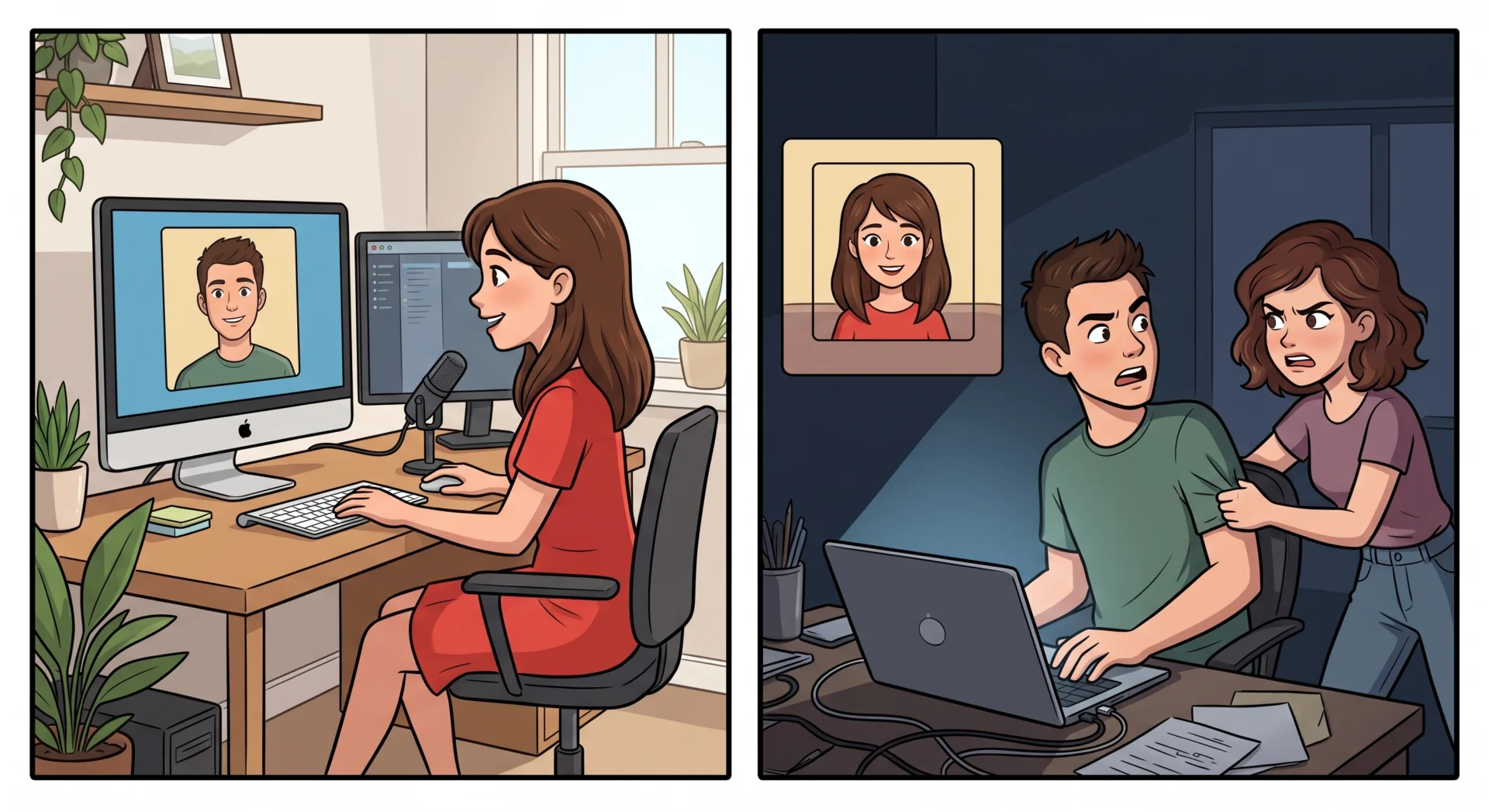
This one is a bit personal. I once dated a guy who was an awesome illustrator and designer—a true artist in every sense of the word. Once, many years ago, he asked if he could help me with my book cover design or something along those lines. He knew I couldn’t afford to pay him what he normally charged others. But he genuinely wanted to help. However, his then-girlfriend-now-wife had other ideas, due to which he had to rescind his offer. I do respect her perspective—I mean, IDK if I would be comfortable with my guy working with his ex, even if it is for a short time.
The good part about working with AI is that we never have to wrestle with issues like that. There’s nothing personal here. Work gets done, and life moves on. I am never going to be on the hit list of the AI’s current girlfriend or wife. Right? 😏
Disclosure: AI Tools I Use
I believe in being honest and up-front. So here it is:
- I use Grammarly to fix my spelling and grammar.
- I use Claude Cowork to brainstorm ideas and transcribe my voice notes and videos.
- I also use Claude Cowork for some tech-heavy, SEO-type work on my website — and it has made my work-life so, so much better.
- Even as we speak, Claude Cowork is helping me fix tech issues in blog post content that I’ve accumulated over 20 years of writing about the Tarot.

Even with all this, there’s one thing that remains purely me: That’s my Tarot, the teaching, the actual thinking. That’s all me. Always will be. 💗 It will always be me who reads your cards or teaches you how to read the cards. And you’ll be there to see it and hear it. Don’t ever worry about that part. 🫶🏼
Tarot and AI: The Case AGAINST: Because I’m Not Naïve
There’s always another side to a story. And I’d be doing you a disservice if I pretended there was nothing on the other side of the scale of the discussion around AI. There’s plenty, and it is serious.
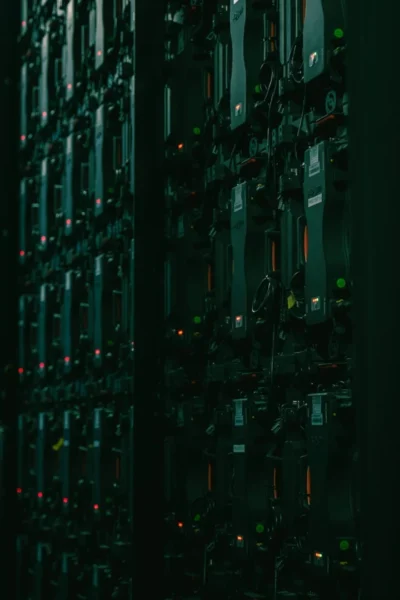
The ethical concerns are real. Data centers — the giant warehouses of servers that AI runs on — guzzle water to keep cool, and when they draw on local supplies and dump wastewater carelessly, that water table gets polluted. People get sick. They pull enormous amounts of electricity and stress local grids. They emit a constant hum that’s been linked to neurological issues for the folks living nearby. All of this burdens everyday people’s wallets. Above all, it burdens Mother Earth, who sustains us. You cannot deny the role that human beings have played in changing our climate in a negative manner.
What really grinds my gears is this: most of these problems are fixable. The companies running these centers just don’t want to spend the money to fix them. To me, that’s not a technology problem. That’s a greed problem.
They prefer to spend millions in donations to election campaigns, in weird ad campaigns telling people that “they care”, and to grease the palms of local officials in the towns where they want to build their data centers.
If only they could spend that money actually fixing the problem, they wouldn’t really face a backlash. I mean, it is absolutely possible to be a good person, do the right thing, and make pots of money as well. But none of these supposedly “brilliant” entrepreneurs seem to be thinking straight anymore. I am genuinely beginning to question this so-called “brilliance”, TBH. Does “brilliance” need to devolve into “monstrous greed”?
Then there’s the copyright issue, which sits close to my heart as a creator. These models were fed mountains of material so they could learn — books, art, articles — and the people who made all that material weren’t credited or paid. That is totally not okay. I’ll talk a bit more about this later.
And there’s the hardware ripple effect. Chips and servers have gotten pricey because these data centers buy them in bulk — chips that’ll be obsolete in a couple of years anyway — while regular people who need a decent computer or smartphone get priced out. Sigh.
Tarot and AI: The Personal Worries
On a more human level, I do wonder: if we lean on these tools too hard, do we forget how to think for ourselves? Interestingly, Tarot and AI work well when we’re researching symbols and myths, or doing other analysis. But I can’t see how I would be able to make a living if somehow an AI or a robot started doing what I did.
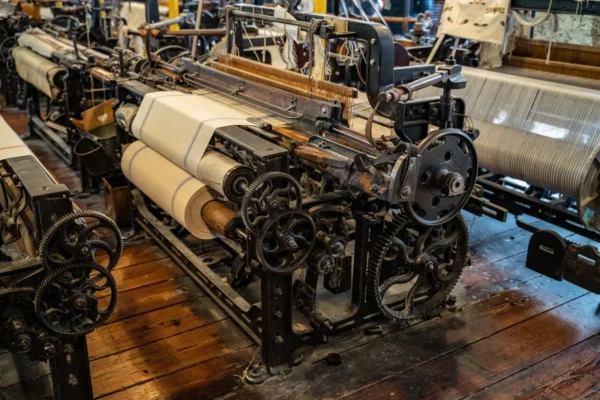
It’s a fair worry. But I keep coming back to the Industrial Revolution — or really any big technological leap. At first, people lost jobs. People weren’t skilled for the new work. It was messy and frightening. And then? People learned. People adapted. Whole new categories of work appeared that nobody could’ve imagined before. I suspect we’re in the messy-and-frightening part right now, and I’d bet on us figuring it out.
An ideal situation would be where corporations do the right thing by the Data Centers and help train people to adapt their skills for this next leap. They could ease people’s fears by coming forward, paying their share of the taxes, and supporting local and national government initiatives to make this happen.
I mean, aren’t we supposed to learn from the mistakes of the past? Shouldn’t we come together so we don’t make those same mistakes again? Wasn’t that the point about being a grown-up and “matured” that you would want to do better than before? Isn’t that what we do as Tarot Card Readers — unfolding the patterns of cause and effect and resolving not to repeat the old patterns in our lives?
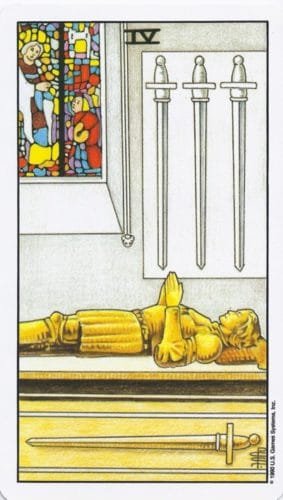
Wasn’t that the whole lesson of the 4 of Swords: Don’t make the same mistakes again?
Tarot and AI: Professional Concerns
For Tarot specifically, I’ve got real reservations about AI-generated readings:
- They tend to be generic. In a previous iteration, you might recall the websites where you’d see an animation of a deck being shuffled, and then you’d click to pick some cards, only to receive a reading that talked about everything and nothing and made no sense whatsoever. AI readings are just slightly better than that.
- They tend to be sycophantic — telling you what you want to hear. AI Models are designed to be “supportive”, which then devolves into sycophancy, where even incorrect or unwise notions and ideas receive resounding validation.
- Where’s the human intuition? That spark, that Pattern Analysis that happens somewhere between the Cards and the reader’s gut? That’s the intuitive hit that tells you which interpretation is the one for the client at the time of the reading. No matter how advanced AI gets, that intuitive approach will likely always remain elusive for it.
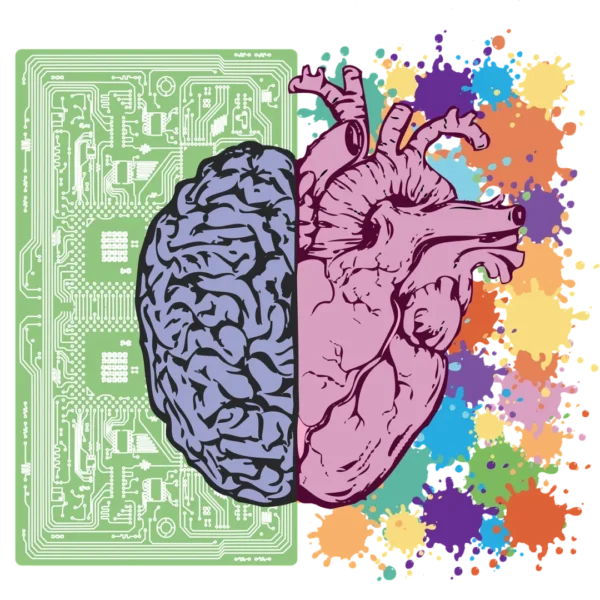
An intuitive Reading will always need a human being. Full stop. AI might hand you keyword meanings and “personalized interpretations” all day long, but it can’t sit with you in the room, feel the weight of your question, and recognize the patterns that imperceptibly show up in the card imagery.
Tarot and AI can mix while intellectually analyzing the card imagery, for example. However, AI can never do what a Tarot Card Reader does when it comes to the one-on-one energetics that play a role during a Tarot Card Reading.
Tarot and AI: The Social Media Side Quest
Coming back to Mary K. Greer.
Mary has always been open about her Tarot and AI experiments. She’s had online debates about the pros and cons — all respectful, all well-articulated, the kind of grown-up disagreement the internet could use more of. Things came to a head when someone, somewhere, decided that meant Mary should be canceled.
As they say on the internet: my flabber was gasted.
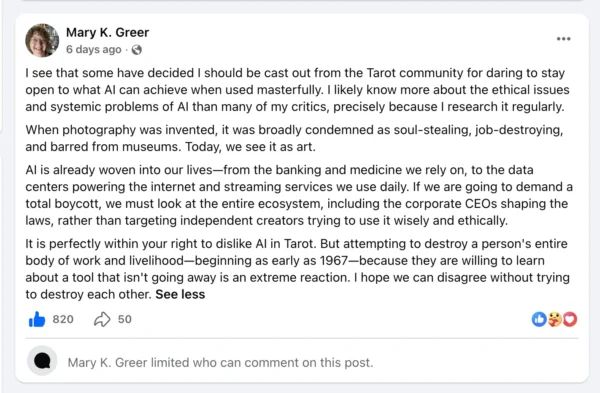
Mary has been talking about her experiments and interactions with AI for years now. People have argued with her in the comments section of those posts. Mary has always listened and expressed her perspective, respectfully and sincerely. How come all this talk about being canceled never came up until now? A little voice in my head keeps nudging me: Why Now? Despite my tingling spider senses, I haven’t investigated more: partly because it isn’t my mystery to solve, but also because I have a feeling that more will eventually unfold.
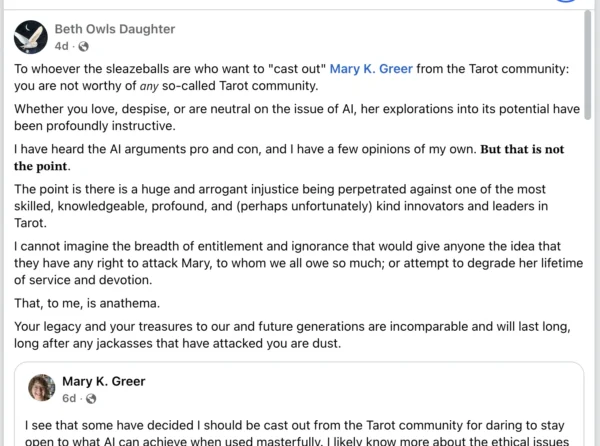
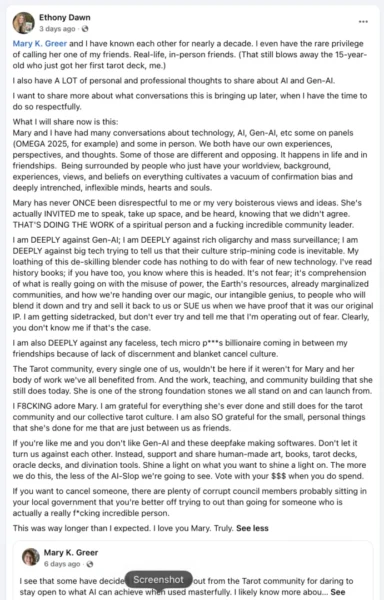
Soon enough, others in the Tarot community stepped up to say, essentially, whoa, hold on. People who disagree with Mary on AI still defended her right to explore it and speak about it without being run out of town. That distinction matters enormously to me: you can dislike Generative AI and still think canceling a thoughtful person for engaging with it is a bad move. Both things can be true.
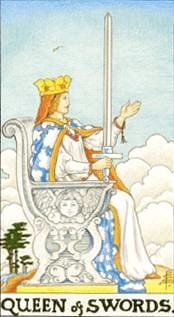
I so love the way Mary engages with AI. In my view, she has used AI as a tool to bounce ideas and notice interesting perspectives. Her adventurous spirit shines forth in her openness and curiosity. I’ve always seen her be a total Queen of Swords with people who made nasty comments — she drew the line at how much and how far she would engage with the nastiness.
Clearly, I’ve lingered on Facebook without speaking out much. I’ll admit to that. The only reason I rarely speak up is that I’m a bit of an introvert. It isn’t obvious because of my Leo Moon + Leo Ascendant. But trust me, there’s a lot under the surface of this iceberg.
Over the past few weeks, even as all of this unfolded, I’ve been brainstorming and mind-mapping this post about Tarot and AI, writing down my case for and against AI. Additionally, I feel all content creators on the Internet should be upfront about their use of AI tools. So I’ve added an AI Policy page to my site. I have a feeling that we’ll all be doing something like this sooner or later – either out of necessity to adhere to some rule, or as a gesture of transparency. Either way, here’s me listening to my intuition and acting upon it by writing about my thoughts about Tarot and AI, and my case for and against AI.
As I said earlier, there are no coincidences. I took the current debate as a sign from the Universe, nudging me to put pen to paper (or in this case, ramble away into the Voice Notes app) and clearly articulate my thoughts about Tarot and AI, and my case for and against AI.
The Strange Collective Shadow Evoked by AI
Let’s come back to our main quest. I’ve always noticed an interesting thing about how people think of AI or AI-adjacent stuff like robots: it evokes a very particular kind of fear. And I don’t think it’s random.
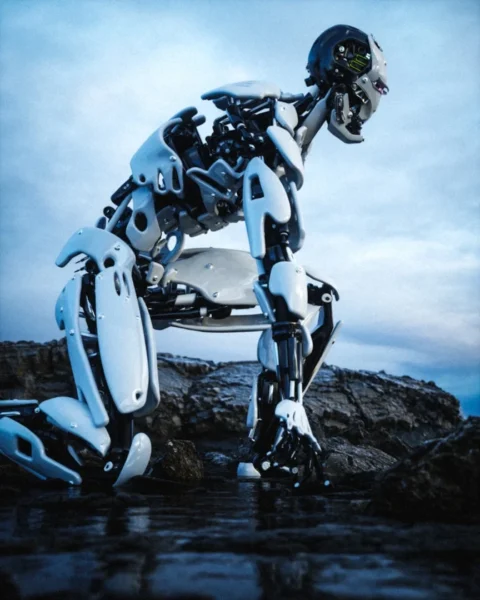
Think about how much our culture conditions us to dread it. Terminator. Robocop. Battlestar Galactica. The 100. Fallout. Even sweet little WALL-E. Over and over, we’ve been told stories where machines take over, nuke us, or subjugate us. Great drama! But I don’t actually think that’s our fate. The Dark Forest Hypothesis, explored in stories like The Three-Body Problem, is intriguing from a very Game Theory point of view, but I hold a different view.
I feel that curiosity will overcome fear. And on occasion, we may encounter something horrible – that’s inevitable. But the chances are much higher that we will encounter something different and interesting, and not necessarily harmful to us.
When we only see the negatives, I think that we’re projecting our Collective Cultural Shadow.
And that fear isn’t entirely unearned. AI was born and raised on everything we as a species have produced. And our track record? Not pretty. Nearly every brilliant innovation we’ve ever created, we’ve eventually bent toward hurting each other. We are spectacular at inventing new ways to do harm, when we could just as easily have used all that genius for something kind.
If that’s the history AI learned from, then it’s fair to worry that our creation will mirror us. Deep down, we know the true face of who we’ve been — and we’re a little disgusted by it. So the fear surfaces in the collective psyche and gets dressed up as killer robots.
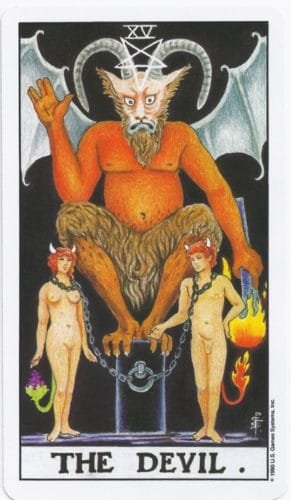
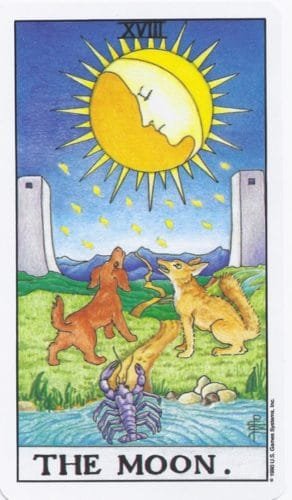
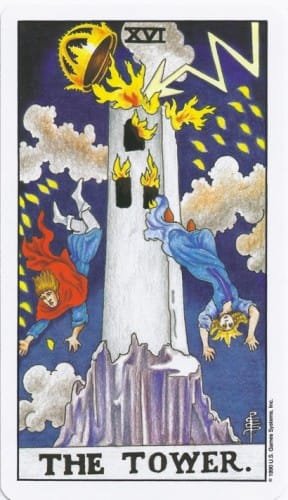
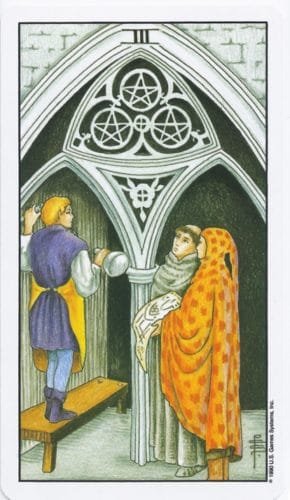
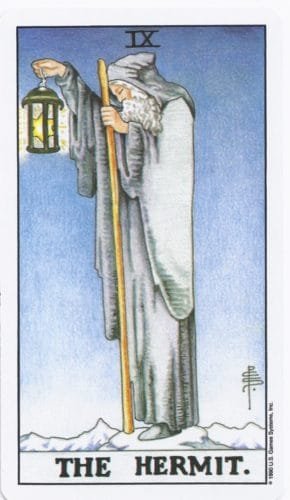
When we free ourselves of the shackles of our Shadow Self and face our Inner Darkness & Fear, the Illusion will shatter, enabling us to rebuild better while adhering to our inner analysis and guidance.
The Tarot reader in me finds that fascinating, not hopeless. Shadows are meant to be looked at, not run from. We must have some sort of a collective reckoning of what we’ve become as a species. We must face those fear-filled shadows and heal them. Once we’ve fallen out of our broken Tower, we must heal and rebuild better. But if we remain trapped in the darkness of our shadowy Devil card energies, we will remain chained to those fears and serve only our inner dark desires. Not that great of an idea, right?
A Nostalgic Side Quest
Let me take you back a bit. Years ago, I worked as a web content developer, and for a tiny part of that time I worked somewhere you could fairly call a content farm.
The business model was simple. We’d bid on projects where our assignment was to “write 10 articles on XYZ topic, with XYZ titles and keywords.” A writer would get an article assignment. They would then Google the keywords, read a stack of existing internet articles on the subject, understand the gist, and then write a fresh article based on what they’d absorbed. An editor would polish it, run it through a plagiarism checker like Copyscape, and off it went to the client.
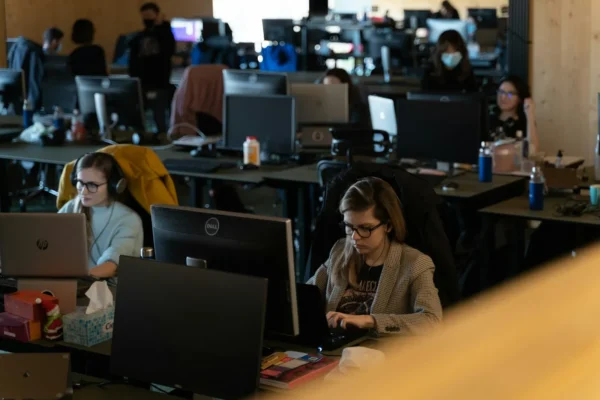
I was reminded of all this when I was trying to understand the mechanics of how AI does what it does.
How LLMs Actually “Think”
Most AIs are essentially Large Language Models (or LLMs, for short). These LLMs work on patterns.
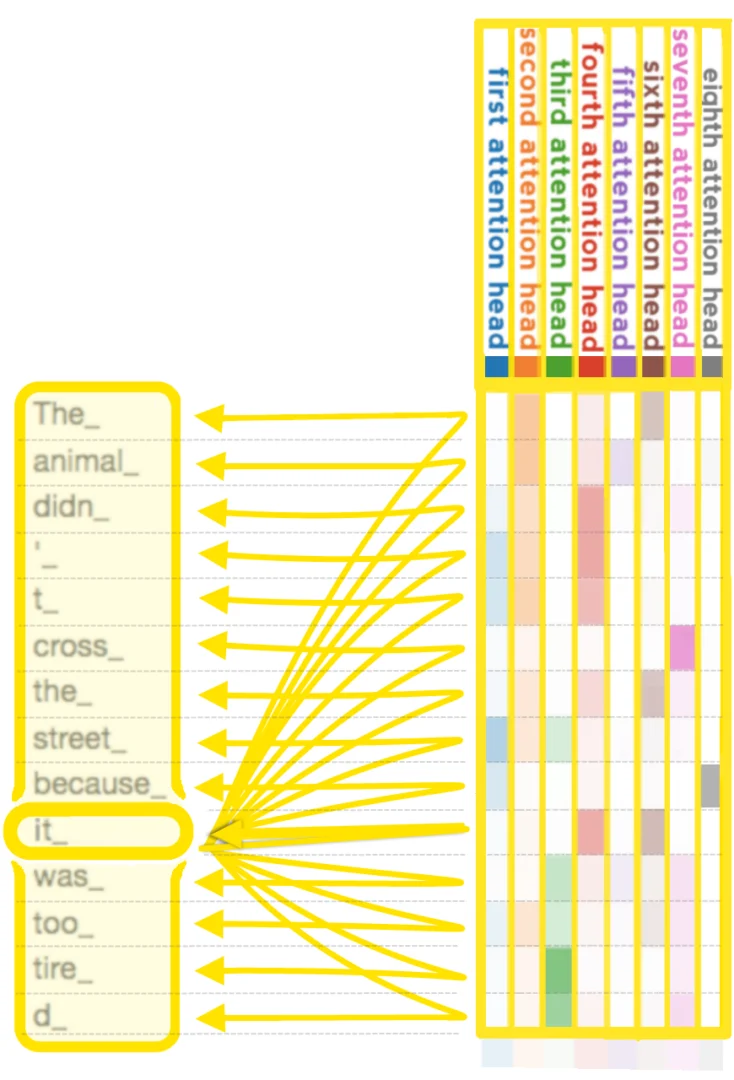
They consume enormous amounts of content, build a kind of pattern-and-prediction map, weigh in the context and your specific question, and then predict which word is likely to follow which — stitching sentences together one probable word at a time.
Which is… pretty much what we content writers were doing in our heads. Read a bunch, absorb the pattern, produce something new in the same shape. The machine just does it faster, smoother, and across far more material than any human could hold at once.
Rinse And Repeat (And The Slop Problem)
This is also why we’re drowning in AI slop. More and more, AI is generating content based on content that other AI generated, and the result reads off. There are language tics a practiced editorial eye catches instantly. I read and hear the ” and honestly…” and something inside me wants to scream out loud. Can we just not do that? I mean, who actually talks or writes like that? 🤷🏻♀️
Tarot and AI: This Is The Hill I’m Willing To Die On
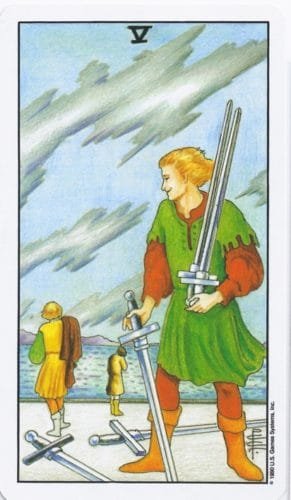
So here’s where I stand. And I’m willing to go full 5 of Swords if I have to. I’ll be the guy who argues and wins the fight, not those two guys who dropped their swords and walked away. Just so you know. 🤺🥹😏
AI is a tool, and it needs to be seen as one. Good or evil depends on the intent of the person wielding it — same as it’s always been, from fire to the printing press to the internet.
AI needs to be seen separately from data centers. Yes, AI needs those centers to run. But the harms coming out of them are fixable, and the corporations dragging their feet need to be held accountable and made to fix them. Don’t blame the tool for the negligence of its landlords.
AI needs boundaries. We can’t allow it to invade every aspect of our lives. We need to set some ground rules about what aspects of our lives it can and cannot access. If we grow too dependent on it, we will lose more autonomy. This is a choice we must make if we hope to retain what makes us human as a species.
We need to learn to use AI ethically. Because if we don’t set good standards — real rules, actually enforced — there will always be someone waiting to misuse it. The systems we build to enforce these standards and rules must be flexible enough to adapt to growth and change, but also solid enough that even small signs of corruption are quickly and easily spotted and dealt with.
And we need to respect creative copyright. The artists and authors whose work trained these models deserve credit and compensation. AI companies can absolutely pay royalties. They just have to choose to.
I mean, at this point, I feel Facebook and Instagram should pay us for being on their site and putting our content and information on there. After all, they mine our data (without our consent) and make tons of money off of it. Shouldn’t we get a cut?
And finally, this one delights the Tarot reader in me: the way LLMs “think” — noticing patterns, mapping them, predicting what comes next — is genuinely close to how a lot of us think. And doesn’t that sound a little like what we do in a Card Reading? Noticing patterns, feeling the cycles, sensing what’s likely to follow? Watching a machine do a mechanical version of that might just teach us something about how our own minds work or don’t work.
I’m not against Corporations making a profit. I’d just rather they do it without harming people or the planet — by being genuinely helpful and genuinely ethical. That would lead people to appreciate their sincere efforts, and they wouldn’t be hated by everyone. And they can keep on innovating. I’d say that’s a win-win situation.
Can we build a world where we use AI safely and wisely, treat creators and contributors with respect, and protect our world, environment, and people from being harmed by our technical innovations? I want to believe that we can. Otherwise, I would quite likely lose all my faith in humanity as a whole. I want to believe that we, as a species, can avoid repeating our past mistakes, and do better, and be better.
Your Thoughts…
Okay, your turn. What’s your stand on AI? Have you been a hesitant-then-curious convert like me, or a firm skeptic, or somewhere in the messy middle? As a Tarot Reader, how do you connect Tarot and AI? Do you use AI in your own creative or spiritual work? If so, how — and where do you draw your line? And that shadow idea — do you think our fear of AI says more about the machines, or more about us? Drop your thoughts in the comments. Let’s have a sincere, grown-up conversation. 🙂